Showing posts with label Aerial Views. Show all posts

Thursday, March 08, 2018

“Would You Pay 50 Cents to Keep the Packers?”


From today’s “Glimpses of the Past”:

“Would You Pay 50 Cents to Keep the Packers?… Are the Packers worth a couple of packs of smokes, a half-pound of coffee or any other four-bit item to you? The figure seems rather fantastic when you place it alongside the price of a new stadium, but here’s how Bernard Darling, co-chairman of the Stadium Ward committee along with Councilman Roman Denissen, explained it at an informal meeting of city councilman, Mayor Otto Rachals, City Atty. Clarence Nier and Packer officials at the Northland Hotel last night:

‘The City of Green Bay’s cost in building the stadium will be approximately $600,000 in 20 years — the original $480,000 plus interest. The Packers’ cost will be the same. Our population should average 60,000 over the next 20 years and probably will go higher. Thus, the average cost per person for the city’s share would be $10 for 20 years.’

“Citizens of Green Bay will vote April 3 on a referendum to decide whether or not the City of Green Bay should issue $960,000 in bonds for the construction of a new stadium, with the Packers bearing half the cost.”

— Green Bay-Press-Gazette, March 13, 1956

We’re glad these “citizens of Green Bay” voted sensibly to build what is widely hailed as one of the places that sports fans need to visit before they die.
Text from today’s Green Bay Press-Gazette

Tuesday, July 01, 2014

Construction Update III

We spent this past weekend moving into our new Green Bay headquarters, which will serve as our nerve center for the upcoming season, starting with the Shareholders’ Meeting on July 24th. On Sunday, we stopped by Lambeau Field to take some more construction photos. Above, a view of the front of the Atrium as it stands now, with the majority of the exterior work finished. Some of the landscaping and pedestrian areas are yet to be completed, and they’re feverishly working to get the new expanded Pro Shop ready for a July 17th opening.

A view from the Oneida Nation Gate platform. All of this will be cleaned up before we see it again.

A view of the East side of the Atrium/administration building. The tall glass entranceway will be the Pro Shop entrance from this parking lot. 

There were plenty of fans milling about this weekend. We did visit the Pro Shop on Saturday, and there were no less than three different wedding parties getting photos taken inside and outside of Lambeau that afternoon.  

The Lambeau Field tour groups were going regularly as well. If you’ve never been to the stadium before or haven’t done a tour in years, we recommend this.

The new indoor practice wing next to the players’ parking lot. 

The players’ entrance to the facilities from their parking lot. 

The players’ parking lot is getting fencing installed now, and will be all nice and secluded by Training Camp time. We are not sure right now what the procedure will be for the tradition of the players riding the local kids’ bikes from here to the practice field. Stay tuned.

Here is a closer-up side view of the entrance to the new Packers Pro Shop, which is under the Atrium. 

This pulled-back view shows the entrance in context.

Coaches Lombardi and Lambeau are in place at the sides of the stairs which lead from the new plaza up to the Atrium floor level. 

Another angle of the North end of the stadium.

The new Pro Shop entrance features designs of both a Packers’ helmet… 

… and the franchise’s logo. We are guessing that these will be backlit and visible along Lombardi Avenue. 

Front view of the new Pro Shop entrance. 

Coach Lombardi watches over the renovated plaza. 

The roadway and pedestrian walkway curve around to met the existing ground level on the North end. 

A more general view of the Lombardi and Lambeau statues area. 

Big changes on the South end of Lambeau Field. The Packers purchased several plots of land in the neighborhood in recent years, and have torn down quite a few houses in the past month. The view above is kind of jarring when you’re not used to seeing the stadium in this context.  

Looking towards Lambeau with a view down an empty Barberry Lane. From what we read, the homeowners were more than fairly compensated.

Crews were working on Saturday to level this field and spread gravel. Then came a layer of hay.

The homes that are left are either slated for future razing, or were not purchased by the team. 

That’s Ridge Road beyond the field. There are four houses on Ridge (South of Valley View Road) that remain, but for how long is uncertain. The team reportedly has agreements that allow some residents to stay for an undisclosed time period.

The corner of Barberry Lane and Barberry Lane. 

A house on Barberry Lane that remains. A pile of dirt sits where a house used to be.

This map shows the area that we’ve been discussing above. The yellow area is where houses have been leveled and turned to field. The four that remain on Ridge can be seen. All of this will be used for media parking, league use, etc. from what we understand.

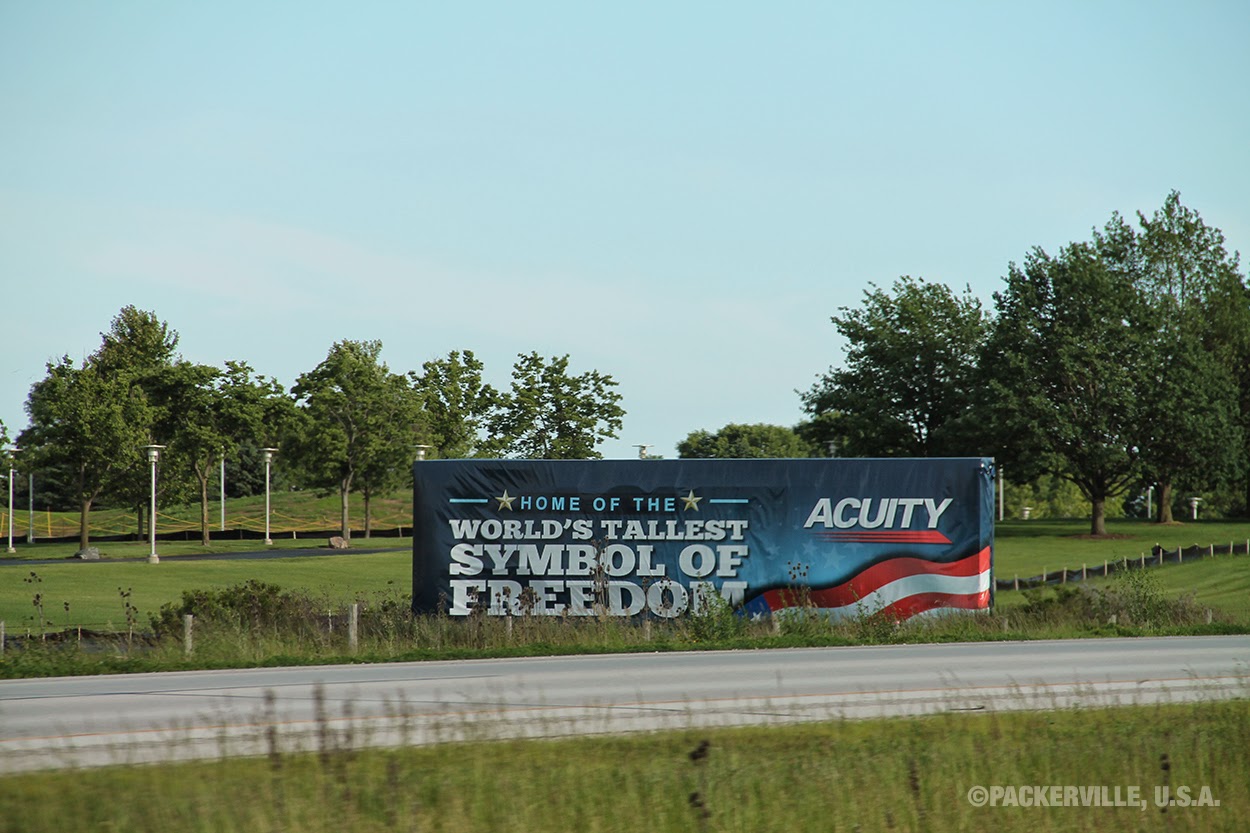
On the drive home, we passed the “World’s Largest Symbol of Freedom,” from what the sign says. It is located at the Acuity Insurance corporate headquarters in Sheboygan, Wis. It is one huge flagpole and flag.

Happy Independence Day, everyone!

Friday, February 28, 2014

Photo Miscellany

As they say, “a picture is worth a thousand words,” right? So, we thought we’d put up a selection of various things that really don’t all relate to each other. Above, we have an aerial view of Green Bay’s new City Stadium being built way out in the boondocks on the city’s western edge. This gives a good look at how the field and most of the stadium’s original seating “bowl” are below ground level.


New City Stadium (later to be renamed Lambeau Field) during the pre-game dedication activities. 32,132 fans attended the first game — a 21-17 upset of the Chicago Bears on September 29, 1957. No officially-licensed Packers apparel anywhere. If you look closely at the left side of the image, we have indicated the approximate location of both our “Green” and “Gold” season ticket seats. Too bad we weren’t alive yet in 1957.

Hearty fans during the NFL’s greatest game — the famed “Ice Bowl” (the 1967 NFL championship) on December 31, 1967. The ’58 NFL championship gets the “Greatest Game” vote everywhere but in the state of Wisconsin. 

Future Hall of Fame FB Jim Taylor at Louisiana State University. 

Packers’ RB Tom Moore tries to elude a Giants’ tackler in the frigid 1962 NFL championship game in New York’s Yankee Stadium. 

Something you don’t get a chance to see too often — heavy earth-moving equipment on the Lambeau Field playing surface during snow removal operations. 

From this year’s Steelers game, an image of the field tarp being removed by the grounds crew. If you go into the stadium when the gates open (usually two hours before game time), you might be able to witness this operation first-hand. 

This has nothing to do with Packers football, but once we saw the photo, it had to go up on the ol’ blog.
Photo credits: Milwaukee Journal-Sentinel, New York Post, Green Bay Packers.

Wednesday, November 02, 2011

The Old Days, As Seen Now

Tying in with some of our coverage of “The Grandstand Franchise” video in the last week is this aerial photo of Green Bay’s East High School and its football field — the former home of the Packers. Known as “City Stadium,” all the teams of the N.F.L. at that time (1925-1956) played here. It was surrounded by wooden bleachers that have long-since been torn down, but the field is in the same location now as it was then. If you’re in town, stop by and take a look. In recent years, they’re re-constructed the decorative gates and noted the historical significance with signs and markers.

Saturday, October 29, 2011

THe Grandstand Franchise — Part III

In Part III of our spotlight on the film “The Grandstand Franchise,” we come to the origin of the Packers. Curly Lambeau, a Green Bay native, had gone to Notre Dame to play football for the legendary Knute Rockne (above).

But after one year, he had to return home because of tonsillitis, and was not able to go back to South Bend to play football the next Fall.

Lambeau is seen with a friend in Green Bay.

And here he is with a lady friend.

Depressed because he missed playing football, he commiserated with an acquaintance from his days of playing high school football.

The acquaintance was the previously mentioned George Whitney Calhoun, sports editor of the Green Bay Press-Gazette. He encouraged Lambeau to hold a football practice and, through the newspaper, encouraged the local men to participate.

Looking down on a Green Bay street in 1919, when the football meeting took place.

Swimming in the bay that summer, something you can’t do anymore.

Early footage of the Green Bay team practicing.

Lambeau looks happy to be playing football again.

Needing sponsorship for the team, Lambeau went to his employer — the Indian Packing Company — and persuaded them to put up the money.

Another view of the Indian Packing Company, which according to the video, went out of business shortly afterwards.

The first Packers team.

They played here for their first four years (1919-1922), at Hagemeister Park, the site on which East High School was built.

For the two seasons (1923-24) that the school was being built, they played here at Bellevue Park.

Another view of the grandstands, looking down the street.

That same view in the early 1980’s. Not all historic sites can be saved.

A game underway at Bellevue Park.

Above and below, these folks look just like the crowd you’d see coming out of a Packers game at Lambeau these days.

When the new East High School was finished, the Packers moved back to play in what was now called City Stadium behind the school. They would play here from 1925-1956. It was considered one of the finest playing surfaces in the league.

These several photos show various views of City Stadium at East High School.

Here’s Coach Lambeau addressing his troops.

And overseeing Packer calisthenics.

Some Twenties game action.

Above and below, the crowd and game action at the Polo Grounds in New York, where the “small town team” played and beat the “big city” team.

Lastly, here are two shots of most of the players on your 1928 Green Bay Packers team.